Norsk Institutt For Kulturminneforskning
Sarpsborg, Østfold, 15 October 2018
Georadar detects a Viking ship in Norway
Archaeologists armed with a motorized high resolution georadar have found a Viking ship and a large number of burial mounds and longhouses in Østfold County in Norway
Here's a short video on youtube
The discoveries were made by archaeologists from the Norwegian Institute for Cultural Heritage Research (NIKU) with technology developed by the Ludwig Boltzmann Institute for Archaeological Prospection and Virtual Archaeology (LBI ArchPro).
The Viking ship find is just below the topsoil, at a depth of approximately 50 cm initially buried in a burial mound.
The digital data visualisations reveal a large and well-defined 20 m long ship-shaped structure. The data indicate that the lower part of the ship is still preserved. Further non-invasive investigations are planned to digitally map the unique find and the wider landscape.
The sensational find is located at Viksletta right next to the monumental Jelle mound in Østfold County, Norway. The team has discovered the traces of at least eight so far unknown burial mounds destroyed by ploughing. But with the help of georadar, the remnants and enclosing ditches of these massive monuments can still be mapped in detail.
One of the former mounds clearly shows the remains of a Viking ship initially buried in the mound.
There are clear indications that the ship's keel and floor timbers are preserved in the grave. Based on other Viking ship finds the archaeologists worked out a first hypothetical reconstruction of the ship.
- We are certain that there is a ship there, but how much is preserved is hard to say before further investigation”, says Morten Hanisch, county conservator in Østfold.
- This find is incredibly exciting as we only know three well-preserved Viking ship finds in Norway excavated long time ago. This new ship will certainly be of great historical significance as it can be investigated with all modern means of archaeology", says
Dr. Knut Paasche, Head of the Department of Digital Archaeology at NIKU, and an expert on Viking ships.
Continue Reading
Showing posts with label Viking Archeology. Show all posts
Showing posts with label Viking Archeology. Show all posts
Monday, November 26, 2018

Tuesday, June 20, 2017
Brewing Viking Beer - With Stones
From the Viking Archeology Blog
When archaeologist Geir Grønnesby dug test pits at 24 different farms in central Norway, he nearly always found thick layers of fire-cracked stones dating from the Viking Age and earlier. Carbon-14 dating of this evidence tells us that ago, Norwegians brewed beer using stones.

Some of the best archaeological finds come from rubbish heaps. Throughout mid-Norway, these rubbish heaps often contain cracked stones that have been used to brew beer [Credit: Åge Hojem, NTNU University
Museum]
There’s nothing archaeologists like better than piles of centuries-old rubbish. Ancient bones and stones from trash heaps can tell complex stories. And in central Norway, at least, the story seems to be that Vikings and their descendants brewed beer by tossing hot rocks into wooden kettles.
“There are a lot of these stones, and they are found at most of the farmyards on old, named farms,” says Geir Grønnesby, an archaeologist at the Norwegian University of Science and Technology’s University Museum.
Grønnesby is fascinated by the history of Norwegian farm settlements, and with good reason. Much of the story of how Norwegian farms were settled and developed over the millennia remains a mystery.
There’s a simple reason for this: most archaeological digs are from construction projects, because developers are required to check for cultural artefacts before beginning construction. It is rare that a developer would build a road or other big development through a farm, which means they are rarely dug up by archaeologists.
In other words, “most of the archaeological information we have about the Viking Age comes from graves, and most of the archaeological information about the Middle Ages comes from excavations in cities,” Grønnesby said. That’s a problem because “most people lived in the countryside.”
Essentially, he says, Norwegian farms are sitting on an enormous underground treasure trove that in places dates from the AD 600, the late Iron Age — and yet they are mostly untouched.
“So I started doing these small excavations to look for cultural layers in farmyards,” he said. “The oldest carbon-14 dates I found are from 600 AD, and all the dates are from this time or later. And when I found the stones, I had to write about them, since there were so many.”
A curious sociologist
Grønnesby is not the first to remark on fire-cracked stones on farms in central Norway. That distinction goes to a pioneering sociologist named Eilert Sundt, who recorded an encounter on a farm in 1851 in Hedmark.
As Sundt later wrote, he was walking and saw a farmer near a pile of strange-looking, smallish stones.
“What’s with these stones?” he asked the farmer, pointing to the pile. “They’re brewing stones,” the farmer told him. “Stones they used for cooking to brew beer — from the old days when they didn’t have iron pots.”
In his article, Sundt noted that most of the farms he visited had piles of burned or fire-cracked stones. Every time he asked about them, the answer was the same: they were from brewing, when the stones were heated until they were “glowing hot” and then plopped into wooden vessels to heat things up. The stones were so omnipresent, Sundt wrote, and so thick and compact in places that houses were built right on top of them.
Reports from archaeologists who examined farmsteads in more recent times also confirm this observation. When one archaeologist dug a test trench in the 1980s at a farm in Steinkjer, north of Trondheim, he found a cultural layer more than a metre thick, much of which was fire-cracked stone.
Grønnesby himself excavated more than 700 cubic metres of stone from a portion of a farmstead in Ranheim, also north of Trondheim. And when Grønnesby did his test sample of the 24 farms, 71 per cent either had cracked stone layers or probably did.
Rituals and the Reformation
It’s not so unusual that Vikings brewed beer using stones, Grønnesby said. Brewing with heated stones has also been reported from England, Finland and the Baltics. It’s a tradition that continues in Germany, where it’s possible even today to buy “stone-brewed beer”.
Grønnesby says the presence of great numbers of brewing stones on Norwegian farms underscores the cultural importance of beer itself.
“Beer drinking was an important part of social and religious institutions,” he said.
For example, the Gulating, a Norwegian parliamentary assembly that met from 900 to 1300 AD, regulated even the smallest details of beer brewing and drinking at that time.
The Gulating’s laws required three farmers to work together to brew beer, which then had to be blessed. An individual who failed to brew beer for three consecutive years had to give half his farm to the bishop and the other half to the King and then leave the country. Only very small farms were exempt from this strict regulation.
What’s equally interesting is when brewing stones disappear from cultural layers — at about 1500, right around the time of the Reformation.
“It could just be a strange coincidence,” Grønnesby said. “It could be religion. Or it could be that iron vessels were more widely available by then.”
From rubbish heaps to treasure troves
Each time a glowing hot brewing stone was plopped into a cold vat of fluid, it would crack. After several of these cycles, the stones would be too small to be useful and the brewers would toss them out onto a rubbish heap.
That means the thick layers of stones also contain other artefacts, like old spinning weights and loom weights, animal bones and beads. It is for this reason, as much as for the stones themselves, that the layers are important, Grønnesby said.
“Archaeologists are always finding these layers, but they used to look at them and scratch their heads, and (the layers) didn’t get the kind of recognition they deserve,” he said. “These layers represent archives from the Viking Age to medieval times, so we should excavate them more often.”
You can read about Grønnesby’s research in the recently published book, “The Agrarian Life of the North: 2000 BC to AD 1000: Studies in Rural Settlement and Farming in Norway”, edited by Frode Iversen & Håkan Petersson. Grønnesby’s chapter is entitled “Hot Rocks! Beer Brewing on Viking and Medieval Age Farms in Trøndelag.”
Author: Nancy Bazilchuk | Source: The Norwegian University of Science and Technology (NTNU) [June 16, 2017]
When archaeologist Geir Grønnesby dug test pits at 24 different farms in central Norway, he nearly always found thick layers of fire-cracked stones dating from the Viking Age and earlier. Carbon-14 dating of this evidence tells us that ago, Norwegians brewed beer using stones.

Some of the best archaeological finds come from rubbish heaps. Throughout mid-Norway, these rubbish heaps often contain cracked stones that have been used to brew beer [Credit: Åge Hojem, NTNU University
Museum]
There’s nothing archaeologists like better than piles of centuries-old rubbish. Ancient bones and stones from trash heaps can tell complex stories. And in central Norway, at least, the story seems to be that Vikings and their descendants brewed beer by tossing hot rocks into wooden kettles.
“There are a lot of these stones, and they are found at most of the farmyards on old, named farms,” says Geir Grønnesby, an archaeologist at the Norwegian University of Science and Technology’s University Museum.
Grønnesby is fascinated by the history of Norwegian farm settlements, and with good reason. Much of the story of how Norwegian farms were settled and developed over the millennia remains a mystery.
There’s a simple reason for this: most archaeological digs are from construction projects, because developers are required to check for cultural artefacts before beginning construction. It is rare that a developer would build a road or other big development through a farm, which means they are rarely dug up by archaeologists.
In other words, “most of the archaeological information we have about the Viking Age comes from graves, and most of the archaeological information about the Middle Ages comes from excavations in cities,” Grønnesby said. That’s a problem because “most people lived in the countryside.”
Essentially, he says, Norwegian farms are sitting on an enormous underground treasure trove that in places dates from the AD 600, the late Iron Age — and yet they are mostly untouched.
“So I started doing these small excavations to look for cultural layers in farmyards,” he said. “The oldest carbon-14 dates I found are from 600 AD, and all the dates are from this time or later. And when I found the stones, I had to write about them, since there were so many.”
A curious sociologist
Grønnesby is not the first to remark on fire-cracked stones on farms in central Norway. That distinction goes to a pioneering sociologist named Eilert Sundt, who recorded an encounter on a farm in 1851 in Hedmark.
As Sundt later wrote, he was walking and saw a farmer near a pile of strange-looking, smallish stones.
“What’s with these stones?” he asked the farmer, pointing to the pile. “They’re brewing stones,” the farmer told him. “Stones they used for cooking to brew beer — from the old days when they didn’t have iron pots.”
In his article, Sundt noted that most of the farms he visited had piles of burned or fire-cracked stones. Every time he asked about them, the answer was the same: they were from brewing, when the stones were heated until they were “glowing hot” and then plopped into wooden vessels to heat things up. The stones were so omnipresent, Sundt wrote, and so thick and compact in places that houses were built right on top of them.
Reports from archaeologists who examined farmsteads in more recent times also confirm this observation. When one archaeologist dug a test trench in the 1980s at a farm in Steinkjer, north of Trondheim, he found a cultural layer more than a metre thick, much of which was fire-cracked stone.
Grønnesby himself excavated more than 700 cubic metres of stone from a portion of a farmstead in Ranheim, also north of Trondheim. And when Grønnesby did his test sample of the 24 farms, 71 per cent either had cracked stone layers or probably did.
Rituals and the Reformation
It’s not so unusual that Vikings brewed beer using stones, Grønnesby said. Brewing with heated stones has also been reported from England, Finland and the Baltics. It’s a tradition that continues in Germany, where it’s possible even today to buy “stone-brewed beer”.
Grønnesby says the presence of great numbers of brewing stones on Norwegian farms underscores the cultural importance of beer itself.
“Beer drinking was an important part of social and religious institutions,” he said.
For example, the Gulating, a Norwegian parliamentary assembly that met from 900 to 1300 AD, regulated even the smallest details of beer brewing and drinking at that time.
The Gulating’s laws required three farmers to work together to brew beer, which then had to be blessed. An individual who failed to brew beer for three consecutive years had to give half his farm to the bishop and the other half to the King and then leave the country. Only very small farms were exempt from this strict regulation.
What’s equally interesting is when brewing stones disappear from cultural layers — at about 1500, right around the time of the Reformation.
“It could just be a strange coincidence,” Grønnesby said. “It could be religion. Or it could be that iron vessels were more widely available by then.”
From rubbish heaps to treasure troves
Each time a glowing hot brewing stone was plopped into a cold vat of fluid, it would crack. After several of these cycles, the stones would be too small to be useful and the brewers would toss them out onto a rubbish heap.
That means the thick layers of stones also contain other artefacts, like old spinning weights and loom weights, animal bones and beads. It is for this reason, as much as for the stones themselves, that the layers are important, Grønnesby said.
“Archaeologists are always finding these layers, but they used to look at them and scratch their heads, and (the layers) didn’t get the kind of recognition they deserve,” he said. “These layers represent archives from the Viking Age to medieval times, so we should excavate them more often.”
You can read about Grønnesby’s research in the recently published book, “The Agrarian Life of the North: 2000 BC to AD 1000: Studies in Rural Settlement and Farming in Norway”, edited by Frode Iversen & Håkan Petersson. Grønnesby’s chapter is entitled “Hot Rocks! Beer Brewing on Viking and Medieval Age Farms in Trøndelag.”
Author: Nancy Bazilchuk | Source: The Norwegian University of Science and Technology (NTNU) [June 16, 2017]
Friday, May 26, 2017
Historians Reveal Amazing Details About Huge Viking Camp Found In Lincolnshire
lincolnshirelive
By Paul Whitelam | Posted: May 19, 2017
Torksey AD 872/873
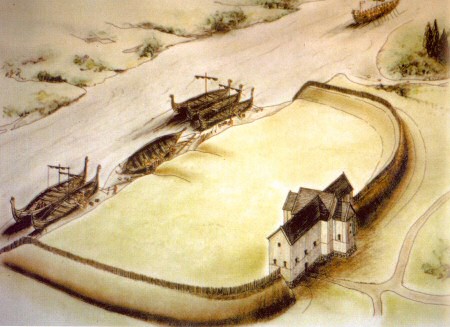
A 1,100-year-old camp the Viking Great Army at Torksey has been brought to life in stunning virtual reality based on the latest research.
Heralded as the most realistic immersive experience ever created of the Viking world, the exhibition at the Yorkshire Museum in York runs from May 19 to November 5.
Three dimensional images and soundscape reveal what life was like in the camp of the Viking army on the banks of the River Trent at Torksey, near Gainsborough, in the winter of AD 872-873, as thousands of Vikings prepared to conquer vast swathes of England.
READ MORE: WOW! 700-year-old silver penny could be yours for just £60
New research by the University of York and the University of Sheffield has been used to create the incredible views of life in the camp for the Viking: Rediscover the Legend exhibition.
The Vikings spent the winter melting down stolen loot, repairing their longships, playing games, fishing, and trading goods and slaves.
The exact location and scale of the camp has been debated for many years, but now research by the two universities is beginning to reveal the truth.
It is now thought to have been at least 55 hectares in size, bigger than many towns and cities of the time, including York.
And the thinking is that thousands, not hundreds, of Viking warriors, women and children lived here in tents.
READ MORE: Your guide to where you can see all 36 statues in the Lincoln Knights' Trail
There have also been more than a thousand finds by metal detectorists and archaeologists, including more than 300 coins.
They include more than 100 Arabic silver coins which would have come to the area through established Viking trade routes.
More than 50 pieces of chopped up silver, including brooch fragments and ingots have been found along with rare hack-gold.
Evidence has been found that these items were being processed at the camp – chopped up to be melted down.
Other finds include the 300 gaming pieces, iron tools, spindle whorls, needles and fishing weights.
All the scenes in the exhibition are based on real objects found by archaeologists and metal detectorists at Torksey.
In 865 AD a large Viking force landed in East Anglia. It is described in the Anglo-Saxon Chronicle, our main contemporary documentary source, as the 'Great Army' as it was much larger than previous raiding parties.
The force seized the Northumbrian capital of York in 867 and went on to wage war against the Anglo Saxon Kingdoms of Mercia and Wessex.
In 871 the army was reinforced from Scandinavia and over the next decade their warfare transformed the political and cultural landscape of Britain.
In 872 AD the army chose Torksey, 13km from Lincoln as a suitable defensive and strategic position for their winter base.
Using landscape analysis, the research has been able to reveal the topography of the camp.
With the River Trent to the west and surrounding land prone to flooding to this day, its strength as a defensive position becomes clear.
Funding for the research has been provided by the British Academy, the Society of Antiquaries of London, and the Robert Kiln Trust.
Professor Julian Richards, from the Department of Archaeology at the University of York, of Meet the Ancestors fame, said: "These extraordinary images offer a fascinating snap shot of life at a time of great upheaval in Britain.
"The Vikings had previously often raided exposed coastal monasteries and returned to Scandinavia in winter, but in the later ninth century they came in larger numbers, and decided to stay.
"This sent a very clear message that they now planned not only to loot and raid – but to control and conquer."
Dr Gareth Beale from York's Digital Creativity Labs added: "The new research by the University of York and Sheffield has been used to create the most realistic images of the camp to date, based on real findings.
"These images are also believed to be the most realistic Virtual Reality ever created anywhere of the Viking world."

An image of the camp. From The Antiquaries Journal
The Virtual Reality scenes have been modelled by Gareth, working with Dr Guy Schofield and Dr Jonathan Hook, both from the Department of Theatre, Film and Television at the University of York, and the acoustic sound track was created by Dr Damian Murphy, Lewis Thresh and Kenneth Brown from the AudioLab in the Department of Electronic Engineering.
Dr Schofield said: "It's been a real cross-disciplinary project and exciting working with the archaeologists and museum professionals to create an authentic but entertaining visitor experience."
The research by Sheffield and York is beginning to reveal the true extent of the camp and the activities that took place there.
Prof Dawn Hadley, who leads the Sheffield side of the project, said: "Torksey was much more than just a handful of hardy warriors – this was a huge base, larger than most contemporary towns, complete with traders, families, feasting and entertainment.
"From the finds we know, for example, that they were repairing their boats here and melting down looted gold and silver to make ingots – or bars of metal they used to trade.
"Metal detectorists have also found more than 300 lead game pieces, suggesting the Vikings, including, women and children, were spending a lot of time playing games to pass the time, waiting for spring and the start of their next offensive.
"The visitor will be transported into this world and able to look around in a 360 degree landscape complete with conversations from the period."

Map produced for The Antiquaries Journal
In a paper published in The Antiquaries Journal, the researchers conclude: "In summary, our research at Torksey has revealed not only the location of the Viking winter camp, but something of its character as well.
"The sheer quantity and value of the metalwork assemblage forces a radical reappraisal of the scale of wealth amassed by the Viking Great Army.
"Plunder was being processed on a massive scale. There was intensive trade and exchange in goods and probably in slaves.
"The evidence from Torksey suggests a hybrid economy with monetary as well as bullion transactions and the minting of coins, reflecting something of the complexity of the multiple economic systems that co-existed during the Viking Age."
As for Torksey, after the Vikings moved out, it developed as an important Anglo-Saxon borough with a major wheel-thrown pottery industry.
The VR experience features alongside star objects from the British Museum and Yorkshire Museum's world class collections in the new exhibition which aims to give fresh perspective on how Vikings shaped every aspect of life in Britain.
It will include the most famous Viking hoards ever discovered in this country, including the Vale of York Viking Hoard, Cuerdale Hoard and the Bedale Hoard.
After York, the exhibition will go on tour to the University of Nottingham Museum, The Atkinson, Southport, Aberdeen Art Gallery and Norwich Castle Museum.
By Paul Whitelam | Posted: May 19, 2017
Torksey AD 872/873
A 1,100-year-old camp the Viking Great Army at Torksey has been brought to life in stunning virtual reality based on the latest research.
Heralded as the most realistic immersive experience ever created of the Viking world, the exhibition at the Yorkshire Museum in York runs from May 19 to November 5.
Three dimensional images and soundscape reveal what life was like in the camp of the Viking army on the banks of the River Trent at Torksey, near Gainsborough, in the winter of AD 872-873, as thousands of Vikings prepared to conquer vast swathes of England.
READ MORE: WOW! 700-year-old silver penny could be yours for just £60
New research by the University of York and the University of Sheffield has been used to create the incredible views of life in the camp for the Viking: Rediscover the Legend exhibition.
The Vikings spent the winter melting down stolen loot, repairing their longships, playing games, fishing, and trading goods and slaves.
The exact location and scale of the camp has been debated for many years, but now research by the two universities is beginning to reveal the truth.
It is now thought to have been at least 55 hectares in size, bigger than many towns and cities of the time, including York.
And the thinking is that thousands, not hundreds, of Viking warriors, women and children lived here in tents.
READ MORE: Your guide to where you can see all 36 statues in the Lincoln Knights' Trail
There have also been more than a thousand finds by metal detectorists and archaeologists, including more than 300 coins.
They include more than 100 Arabic silver coins which would have come to the area through established Viking trade routes.
More than 50 pieces of chopped up silver, including brooch fragments and ingots have been found along with rare hack-gold.
Evidence has been found that these items were being processed at the camp – chopped up to be melted down.
Other finds include the 300 gaming pieces, iron tools, spindle whorls, needles and fishing weights.
All the scenes in the exhibition are based on real objects found by archaeologists and metal detectorists at Torksey.
In 865 AD a large Viking force landed in East Anglia. It is described in the Anglo-Saxon Chronicle, our main contemporary documentary source, as the 'Great Army' as it was much larger than previous raiding parties.
The force seized the Northumbrian capital of York in 867 and went on to wage war against the Anglo Saxon Kingdoms of Mercia and Wessex.
In 871 the army was reinforced from Scandinavia and over the next decade their warfare transformed the political and cultural landscape of Britain.
In 872 AD the army chose Torksey, 13km from Lincoln as a suitable defensive and strategic position for their winter base.
Using landscape analysis, the research has been able to reveal the topography of the camp.
With the River Trent to the west and surrounding land prone to flooding to this day, its strength as a defensive position becomes clear.
Funding for the research has been provided by the British Academy, the Society of Antiquaries of London, and the Robert Kiln Trust.
Professor Julian Richards, from the Department of Archaeology at the University of York, of Meet the Ancestors fame, said: "These extraordinary images offer a fascinating snap shot of life at a time of great upheaval in Britain.
"The Vikings had previously often raided exposed coastal monasteries and returned to Scandinavia in winter, but in the later ninth century they came in larger numbers, and decided to stay.
"This sent a very clear message that they now planned not only to loot and raid – but to control and conquer."
Dr Gareth Beale from York's Digital Creativity Labs added: "The new research by the University of York and Sheffield has been used to create the most realistic images of the camp to date, based on real findings.
"These images are also believed to be the most realistic Virtual Reality ever created anywhere of the Viking world."
An image of the camp. From The Antiquaries Journal
The Virtual Reality scenes have been modelled by Gareth, working with Dr Guy Schofield and Dr Jonathan Hook, both from the Department of Theatre, Film and Television at the University of York, and the acoustic sound track was created by Dr Damian Murphy, Lewis Thresh and Kenneth Brown from the AudioLab in the Department of Electronic Engineering.
Dr Schofield said: "It's been a real cross-disciplinary project and exciting working with the archaeologists and museum professionals to create an authentic but entertaining visitor experience."
The research by Sheffield and York is beginning to reveal the true extent of the camp and the activities that took place there.
Prof Dawn Hadley, who leads the Sheffield side of the project, said: "Torksey was much more than just a handful of hardy warriors – this was a huge base, larger than most contemporary towns, complete with traders, families, feasting and entertainment.
"From the finds we know, for example, that they were repairing their boats here and melting down looted gold and silver to make ingots – or bars of metal they used to trade.
"Metal detectorists have also found more than 300 lead game pieces, suggesting the Vikings, including, women and children, were spending a lot of time playing games to pass the time, waiting for spring and the start of their next offensive.
"The visitor will be transported into this world and able to look around in a 360 degree landscape complete with conversations from the period."
Map produced for The Antiquaries Journal
In a paper published in The Antiquaries Journal, the researchers conclude: "In summary, our research at Torksey has revealed not only the location of the Viking winter camp, but something of its character as well.
"The sheer quantity and value of the metalwork assemblage forces a radical reappraisal of the scale of wealth amassed by the Viking Great Army.
"Plunder was being processed on a massive scale. There was intensive trade and exchange in goods and probably in slaves.
"The evidence from Torksey suggests a hybrid economy with monetary as well as bullion transactions and the minting of coins, reflecting something of the complexity of the multiple economic systems that co-existed during the Viking Age."
As for Torksey, after the Vikings moved out, it developed as an important Anglo-Saxon borough with a major wheel-thrown pottery industry.
The VR experience features alongside star objects from the British Museum and Yorkshire Museum's world class collections in the new exhibition which aims to give fresh perspective on how Vikings shaped every aspect of life in Britain.
It will include the most famous Viking hoards ever discovered in this country, including the Vale of York Viking Hoard, Cuerdale Hoard and the Bedale Hoard.
After York, the exhibition will go on tour to the University of Nottingham Museum, The Atkinson, Southport, Aberdeen Art Gallery and Norwich Castle Museum.
Thursday, February 2, 2017
The Viking Age Should Be Called The Steel Age
Science Nordic

After the Danish defeat at Dybbøl in 1864, Danes needed to remember the former glory days of the Vikings. The Viking Age represents a time when the Danes were notorious warriors. (Photo: Shutterstock)

After the Danish defeat at Dybbøl in 1864, Danes needed to remember the former glory days of the Vikings. The Viking Age represents a time when the Danes were notorious warriors. (Photo: Shutterstock)
OPINION: The
Viking Age harks back to the glory days of the Nordics, but the name is
all wrong. It should instead be called the Steel Age, says Danish
archaeologist.
Keywords:
Archaeology, Vikings
The Stone Age, the Bronze Age, and the Iron Age… All follow the most
widely recognised method of categorising historical cultural
development.
It was Christian Jürgensen Thomsen who developed the three term system at the start of the 19th century and in doing so, created order out of a chaotic pre-Christian chronology in the Nordics.
One hundred years later, one of his students, J. J. A. Worsaae, placed the Viking Age in between the Iron Age and the Middle Ages.
The Viking Age however, was not a methodical tool, but an intermediate period of time between the other two--a political manifestation from 1864.
Back then, Danes embraced the nostalgia of the Viking Age heyday. And they still do today.
Perhaps the Viking Age appeals to us today, because it is perceived as a time in which Denmark, as we know it today, took shape, with borders, written language, cities, a monetary economy, and the spread of Christianity.
So when it comes to the Viking Age, archaeologists are biased in a completely different way than if it was one of the three preceding ages. The very word Viking gets in the way.
Generally speaking, all Danes know about the Vikings and the Viking Age, but on an academic level, it is difficult to penetrate deeper into the period. And archaeologists often find it difficult to answer even relatively simple questions about the Vikings.
All would agree that looting, conquests, and colonisation were important to the people who actively participated in it, and to the powerful elite who organised and profited from it.
But were the Viking raids important for the population as a whole or to ordinary farmers?
Or more precisely: can we separate plundering in the 800, 900 and early 1000s from plundering in other periods? Or were they just a continuation of a certain practice with improved technology?
Continue Reading
Makes sense.
Viking Smiths weren't just pouring liquid iron into molds for swords.
It was Christian Jürgensen Thomsen who developed the three term system at the start of the 19th century and in doing so, created order out of a chaotic pre-Christian chronology in the Nordics.
One hundred years later, one of his students, J. J. A. Worsaae, placed the Viking Age in between the Iron Age and the Middle Ages.
The Viking Age however, was not a methodical tool, but an intermediate period of time between the other two--a political manifestation from 1864.
Back then, Danes embraced the nostalgia of the Viking Age heyday. And they still do today.
The Viking Age teases archaeologists
We still celebrate the Vikings with Viking markets, games, and festivals, and it has become quite an economically lucrative slice of the tourism industry.Perhaps the Viking Age appeals to us today, because it is perceived as a time in which Denmark, as we know it today, took shape, with borders, written language, cities, a monetary economy, and the spread of Christianity.
So when it comes to the Viking Age, archaeologists are biased in a completely different way than if it was one of the three preceding ages. The very word Viking gets in the way.
Generally speaking, all Danes know about the Vikings and the Viking Age, but on an academic level, it is difficult to penetrate deeper into the period. And archaeologists often find it difficult to answer even relatively simple questions about the Vikings.
Plundering, conquest, and colonisation
A historian would immediately say that the Viking Age began with the looting of the monastery on Lindisfarne in 793 CE and ended with the Battle of Stamford Bridge in 1066. But archaeologists ask how cultural development in Denmark can be defined by events in the British Isles, and whether activities outside Scandinavia had any significance for the cultural-historical development of Scandinavia.All would agree that looting, conquests, and colonisation were important to the people who actively participated in it, and to the powerful elite who organised and profited from it.
But were the Viking raids important for the population as a whole or to ordinary farmers?
Or more precisely: can we separate plundering in the 800, 900 and early 1000s from plundering in other periods? Or were they just a continuation of a certain practice with improved technology?
Continue Reading
Makes sense.
Viking Smiths weren't just pouring liquid iron into molds for swords.
Friday, January 13, 2017
Viking Archeology Blog Has 2 More: Still Discovering, Still Learning, Still Fascinating
Viking Archeology Blog
Thursday, 12 January 2017
Bringing Vikings Back to the East Midlands
The Centre for the Study of the Viking Age is pleased to report that we have been awarded a substantial grant from the Arts and Humanities Research Council Follow-On Fund for a project called Bringing Vikings Back to the East Midlands. The project will fund a variety of initiatives and events related to the British Museum/York Museums Trust travelling exhibition on the Vikings which will be on at Lakeside from November 2017 to March 2018. CSVA alumnus Dr Roderick Dale will start as Cultural Engagement Fellow on the project on 1st February. More details to follow.
Read the rest of this article...
Read the rest of this article...

Tuesday, 20 December 2016
Dressed up with bling stolen in Viking raids

When a female
Norwegian Viking died some time during the 9th century, she was buried
wearing a status symbol: a beautiful piece of bronze jewellery worn on
her traditional Norse dress.
In the summer
of 2016, 1200 years after her death, the piece of jewellery was found by
chance at Agdenes farm, at the outermost part of the Trondheim Fjord in
mid-Norway. The well-preserved object is an ornament with a bird figure
that has fish- or dolphin-like patterns on both "wings."
The decorations
suggest that the jewellery was made in a Celtic workshop, most likely
in Ireland, in the 8th or 9th century. It was originally used as a
fitting for a horse's harness, but holes at the bottom and traces of
rust from a needle on the back show that it had probably been turned
into a brooch at a later stage.
Friday, December 16, 2016
Viking Archeology: 3 From Viking Archeology Blog
Still discovering. Still Learning.
Viking Archeology Blog
Sunday, 11 December 2016
Viking gold discovered in Denmark – on live TV

The
new find was made in the same field that yielded these seven bracelets
over the summer. Photo: Nick Schaadt, Museet på Sønderskov
A team of
Danish archaeologists digging in a field east of Ribe knew they had a
better-than-average chance of discovering a treasure trove.
They were, after all, digging in the same field that back in June produced the largest ever discovery of Viking gold in Denmark.
Having discovered seven bracelets, six gold and one silver, that date
to around the year 900 the archaeologists went back to the field on
Monday.
This time they had a production crew from regional broadcaster TV Syd in tow.
Already by
midday, the archaeologists and the TV crew had cause to celebrate. In
front of rolling cameras, the excited diggers pulled out what appeared
to be part of another Viking gold bracelet.
Rare 1,500 Year Old Odin Amulet Found In Denmark
A local treasure hunter named Carsten Helm, along with his 10 and 12-year-old sons, discovered a trove of gold on the island of Lolland that dates back 1,500 years.

The Odin amulet was called a "rare and exciting discovery"
[Credit: Museum Lolland-Falster]
Among the gold discovered was a so-called bracteate, a thin gold medallion worn as jewellery during the Germanic Iron Age. Archaeologists at Museum Lolland-Falster believe that the image on the amulet depicts Nordic god Odin. Their conclusion was based on other finds of similar bracteates that include a rune inscription reading ‘The High One’, one of Odin’s nicknames.
“It is a very exciting find,” museum spokeswoman Marie Brinch said. “Even though it is a previously-known type, it is a rare and exciting discovery. Throughout history there have only been three found on Lolland, the latest in 1906, and in all of Northern Europe there are only around 1,000 of them.”
Helm and his sons also found an additional gold pendant, three gold pieces that were likely parts of a necklace, a gold ring and assorted pieces of silver.
Their finds will go on display at the Maribo County Museum on Friday.
Read the rest of this article...
Tuesday, 6 December 2016
Somerset skeletons are oldest evidence of monks found in UK
Carbon dating of remains unearthed in Beckery chapel near Glastonbury indicate monastic life dating back to fifth or early sixth centuries
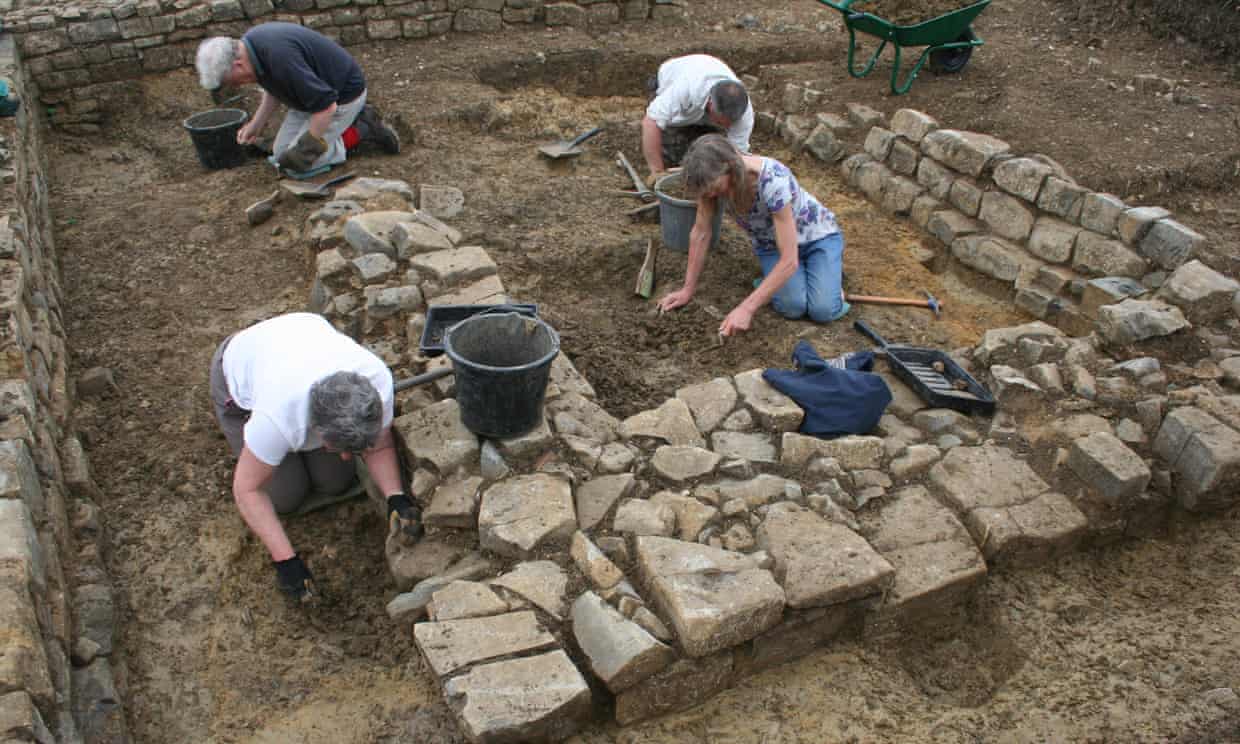
Skeletons excavated at a site near Glastonbury are the oldest examples of monks ever found in the UK, carbon dating has proved.
The remains,
unearthed at the medieval Beckery chapel in Somerset, said to have been
visited by legendary figures such as King Arthur and St Bridget,
indicate a monastic cemetery dating back to the fifth or early sixth
centuries AD, before Somerset was conquered by the Saxon kings of Wessex
in the seventh century.
Archaeologists
first located an extensive cemetery of between 50 and 60 bodies during
an excavation in the 1960s. The fact all were male – apart from one
female, thought to have been a visitor, nun or patron, and two
juveniles, who may have been novices – left little doubt this was a
monastic graveyard.
Read the rest of this article...
Thursday, September 8, 2016
New Viking Graves Discovered In Denmark
from Science Nordic
August 31, 2016 - 06
August 31, 2016 - 06
A new archaeological excavation in Denmark reveals the remains of graves and buildings that span the Stone Age, Bronze Age, the Vikings, and right up to the Middle Ages.
Archaeologists are busy unearthing the traces of three thousand years of activity at Silkeborg, west Denmark.
Excavations have already revealed pit-houses, which were typically used as workshops during the Viking era, and residential homes in the so-called Trelleborg style (see Fact Box), together with several graves.
At least two of the graves could have accommodated high-status Vikings.
“There’s been activity here at least since the Stone Age,” says one of the archaeologists involved in the dig, Maria Thiemke, from the Silkeborg Museum, Denmark.
“There’s at least 14 houses and five graves from the Stone Age, Bronze Age, right up until the Middle Ages,” says Thiemke.
Even though she expected the site to reveal lots of archaeological finds, both Thiemke and her colleague, archaeologist Rikke Isler from Silkeborg Museum, were both surprised by the richness of the finds.
“The graves are located close to a church from the Middle Ages and that’s often an indication that there’s been activity on the site for a long time. But what we’ve found is a jigsaw puzzle with lots of pieces and probably from six, seven, or eight different games,” says Isler.
See some of the finds in the gallery above.
Burial site for a high-status lady
Earlier in the year, Thiemke and Isler unearthed the remains of posts from several houses at a test-site. So they sought funding to investigate further. They are now excavating five hectares of the site.
As they began to dig, they discovered two red patches of rusty soil in a corner of one of the graves.
“We could hear one of our colleagues shout “It’s metal!” and coincidentally one of our metal detectors was on site. He also found metal in the opposite corner of the grave, so we dug and found a klinker nail--a special type of nail,” says Thiemke.
A klinker nail indicates that the grave could have contained a wagon. This type of grave was usually reserved for women of high social status, nobility or great wealth.
Subscribe to:
Posts (Atom)
-
Volume 1, Grab The Wolf is FREE Available on iPhone, iPad, iPod touch, and Mac. Volume 2, Kill Them Twice is FREE Volume 3, The Valky...

